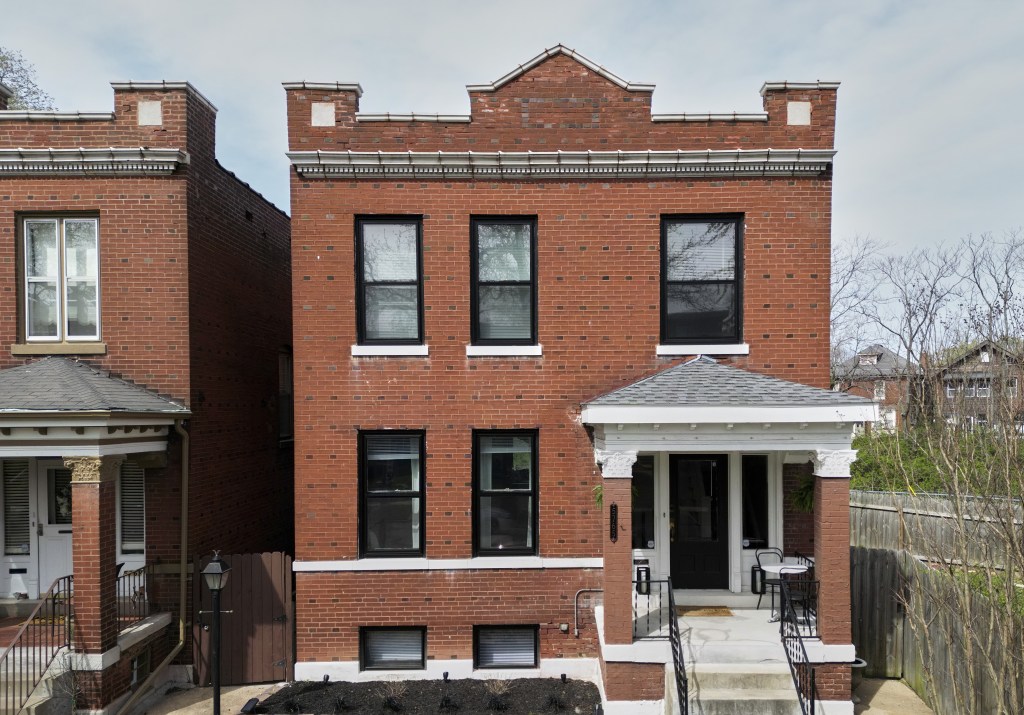
Following the 1904 World’s Fair, Skinker DeBaliviere turned from farmland to a dense urban neighborhood. For more on the broader neighborhood history, consider reading Celebrating Skinker DeBaliviere – it is as fine a neighborhood history as I’ve ever read. By 1912 in the southeastern corner of the neighborhood, an R.O. Brown Real Estate Company applied for building permits at 5765-67-69-71 Pershing Avenue. At that time, prior to World War I and the anti-German sentiment that would accompany the conflict, the street was still named Berlin Avenue. There is some likelihood that R.O. Brown was Reasor-Brown, a prominent home builder in the area during the early 20th century. The company built middle to upper class housing throughout St. Louis’ west end and out into county suburbs including Clayton. The permits were for $12,000 (roughly $370,000 today adjusted for inflation). All four buildings were to be brick single family homes at two stories tall. As one can witness in the present day, the four detached rowhomes are nearly identical save for stylistic differences in the paint schemes.
When the four detached rowhomes were completed later that year, it appears that an out-of-town investor bought both 5765 and 5767 Pershing and rented out the houses for $50 a month, a higher-end price tag at the time. This equates to a sum of $1,536 in 2022 when adjusting for inflation. The 7-room home at 5765 Pershing had a tile porch, tile bath, steam heat, copper screens, and copper guttering in addition to the many features such as columns and stained glass that are still present on the home today. It is readily apparent that highly skilled laborers built the home.
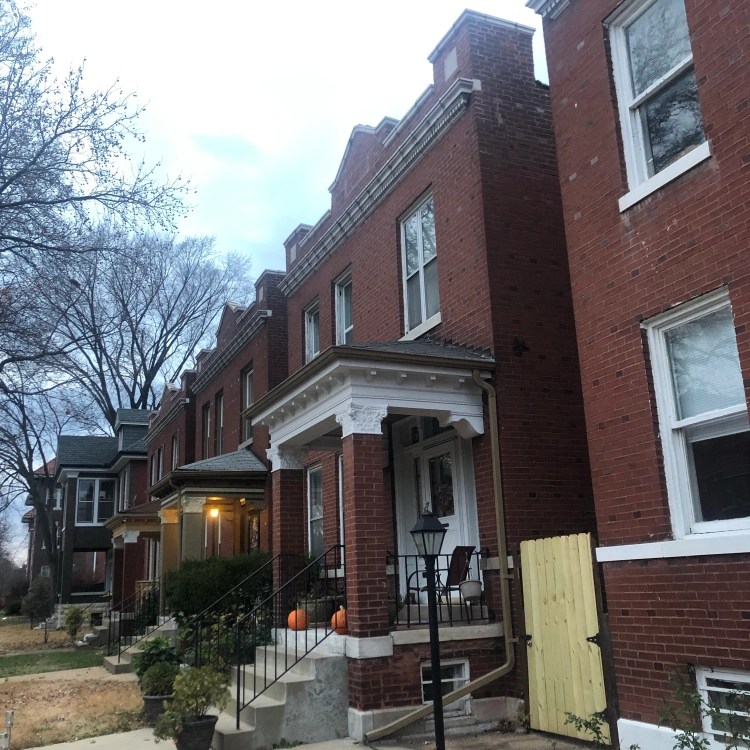
In 1914, a salesman named J Forbes Johnson lived at the address. He worked at 908 Clark Street downtown. His wife spent her career as a music teacher at Clayton High School and John Burroughs School. Mentions of them at the address are limited to 1914, so it is difficult to say how long they lived there. Whoever rented the home in 1916 not only had the money for rent, but also put out an advertisement seeking a housekeeper. This practice was common early on in the neighborhood due to the wealth of the residents. While some homes on the neighborhood’s western half had live-in quarters for housekeepers, this home was more modest in its intent. In 1917, the out-of-town investor moved to sell the home. It must have been difficult during WWI, because the house remained on the market until at least 1919 when it was listed for $5,500. Depending on the new construction sale price, which is lost to time, this listing price potentially represented a small to moderate profit.
In 1920, a Jewish family by the name of Herman resided there as evidenced by their son’s wedding posted in the paper. Both Jacob and his wife Malla were Russian immigrants. The 1920 census lists four family members living at the home. The patriarch Jacob Herman was the proprietor of a dry goods store at 1322 S Broadway in the Kosciusko neighborhood. Jewish families were common on St. Louis’ west side. Soldan High School, designed by William B. Ittner (interestingly, the inspector of the property shared the same last name in the 1923 listing), was a heavily Jewish high school from its opening date in 1909. The house was again listed for sale in 1923 highlighting wainscotting (removed during an undocumented later renovation) in the bathroom and oak floors throughout the home. The price tag was $9,000. Neighbors during these years included an Irish Immigrant sportswriter by the name of John Sheridan and the owner of the first Ford dealership in St. Louis, William Johnson.

From roughly the mid 1920s through the 1950s, it appears that the family of John Joseph O’Neill lived in the house. Prior to moving to the residence, he had lived in the Fountain Park neighborhood at 923 Walton Ave. The first mention of the O’Neill’s at the home is in a 1926 newspaper note about a child’s birth. By 1930, the home was valued at $10,000. Due to the Great Depression, the home’s value receded to $6,000 in 1940. The home was also coming up on thirty years by that point and surely needed some maintenance and updating. In 1931, an exchange listing was placed. This listing mentions a garage, which is oddly the only hint that a garage ever existed on the property. Aerial views from 1958, the earliest that I have been able to view, do not show a garage on the property.
The commonality of John J. O’Neill’s name makes it challenging to source information. Census data states he was the son of Irish Immigrants. It is possible O’Neill attended St. Louis University High School and, if so, would appear to have been well connected socially. His occupation was as a buyer at a department store. The 1940 census lists seven family members living at the home. One of those children was Donald O’Neill who attended the prestigious Irish Catholic McBride High School on the northside (it was most recently Hawthorne). In 1952, an announcement was made for one son’s engagement to a Joan Margaret Murphy. Their marriage took place a year later and a picture of Joan Margaret Murphy is included. The couple was married at the local Catholic parish, St. Roch’s – a beautiful gothic revival church that spoke to the Catholic heart of the community in the early 20th century. This is the last mention of the O’Neill family at this residence. Their story supports the neighborhood’s reputation of having a strong Irish Catholic population in the mid-20th century. By 1958 Kenneth McGinnis, an accountant at the St. Louis Art Museum, had moved into the home. That year, he passed away. In 1964, a foreman at Lillie-Hoffman Cooling Towers named Henry Hoffman lived at the home. By the early 1960s, the neighborhood was undergoing radical change. It had become one of the most integrated neighborhoods in both St. Louis and the United States.
In 1966, the property was once again listed for sale. A black married couple by the name of Horace and Anna Busch who had both grown up in Mill Creek Valley attending St. Malachi’s Catholic Church bought the home. They married in 1952 and raised six children. Horace Busch served in the U.S. Air Force earning an Air Force Outstanding Unit Award and likely bought the home through the G.I. Bill as it was advertised in the listing. Again, this transaction shows a larger trend as many black residents moved to Skinker DeBaliviere in the decade after Mill Creek Valley was leveled. Black residents first started buying homes in Skinker DeBaliviere in 1963, but likely lived in rentals there starting in the 1950s. The property was put up for sale at a price tag of $89,900 in 1987 (roughly $243,000 today adjusted for inflation). But it did not sell for unknown reasons. The home was again listed for sale in 1997 for $140,000 (roughly $270,000 today adjusted for inflation). However, it does not appear it sold as the Busch family maintained ownership.

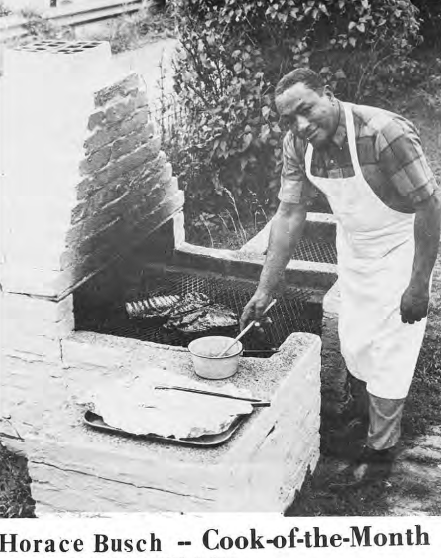
Horace and Anna Busch were heavily involved in the neighborhood from the moment they bought the house, contributing to the diverse and inclusive neighborhood character that bucked national trends. Horace and Anna Busch were active parishioners at St. Roch’s, and Anna served on the Skinker DeBaliviere Community Council. Her name is featured throughout “The Paper,” Skinker DeBaliviere’s homegrown monthly newspaper. In the early 1970s, the Busch family opened their home for the Skinker DeBaliviere House Tour. The Busch family lived in the home until their passing in the early 2010s and were well regarded by neighbors and leaders of the community. While they had several children, Former Mayor Lyda Krewson remembers them fondly mentioning that she spent many a night at their dining table talking political strategy for the ward.
5765 Pershing has a remarkably intact history considering the change the neighborhood has undergone in its first century. Throughout its first one hundred years, the home has represented the cycles of demographic changes and given a glimpse into the various residents that lived in the neighborhood.
 Tony Chiado
Leave a comment