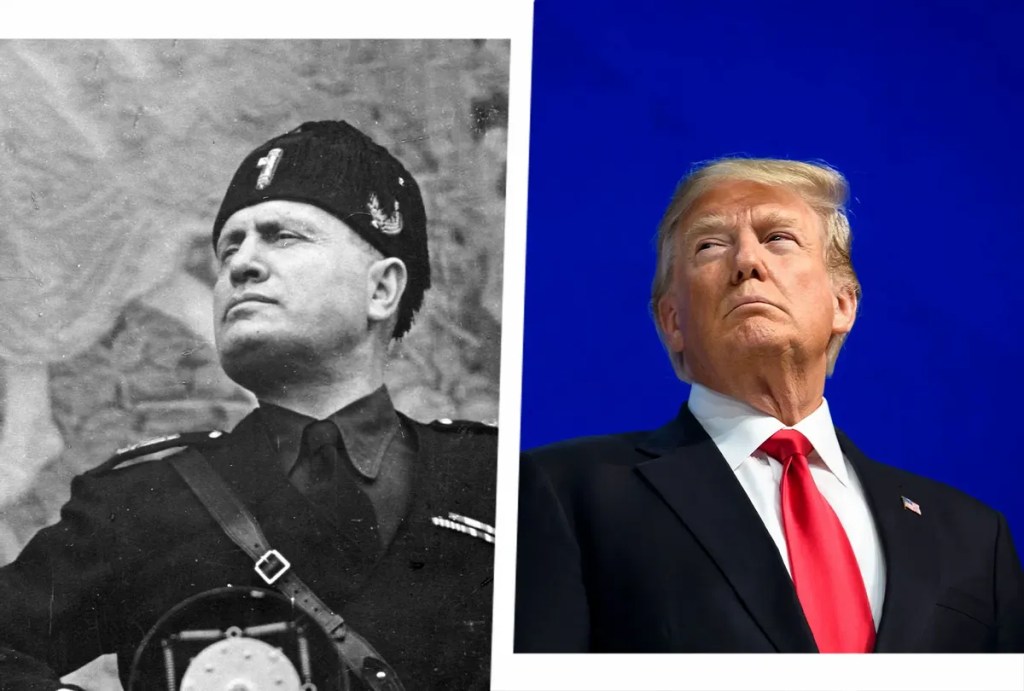
I know many people that are confounded by how fascism could rise up in an established, affluent, and healthy nation like America. I’ve bounced around a number of theories in my own head, but one recently came into clearer focus. I was gifted Christopher Duggan’s A Concise History of Italy for Christmas. In its early pages, Duggan wrote this about the early Italian state and its descent into fascism under Mussolini:
“Initially, there was some hope that the introduction of liberal institutions and free trade would unleash the pent up talents and energies of a people who had given the world the civilization of Ancient Rome and the Renaissance; and the new prosperity, it was imagined, would generate support for the liberal order and its leaders. This soon proved illusory. By the late 1870s, socio-economic unrest had begun to erode the old certainties. Disillusionment grew; and other less liberal political ideas surfaced that claimed to solve the problem of how to generate in Italians feelings of commitment to the state. These ideas culminated in the fascist experiment of the 1920s and 1930s” (p. 2).
Between 1861 and the 1920s, a newly-formed unified Italy slid from ambitions of freedom to fascist dystopia. It strikes me that America, though not perfectly mapped, has experienced a similar descent into fascism meeting the present moment of the Trump regime. Consider that the Civil Rights Movement of the 1950s and 60s, with strong government support in Lyndon B. Johnson’s Great Society, newly formed a united America. Where the Risorgimento unified Italy across regional disputes, the Civil Rights movement unified America across racial disputes.
America, too, in its era of great prosperity following WWII, surely felt it could weather the socio-political challenges of racial unification. But as the economic narrative declined in the 1960s and 1970s, Americans largely rejected social integration through white flight and busing protests. Like Italy in the 19th century, in the final decades of the 20th century America saw its populace turn away from progressive ideals and towards conservatism. This slide was not immediate, nor linear. But the trajectory has been clear, save, perhaps, for Obama’s two-term presidency which sparked a hope that demographics would swing the country back toward a progressive future.
America had, and has, long existed as a fragmented nation. One with different Americas for different racial groups. And the attempt of the Civil Rights Movement to forge a unified nation was met with a backlash that has welcomed fascism into the White House. Not once, but twice. And more severely this time around.
Duggan continued on with his assessment of fascism:
“The fascist regime strove resolutely to instill in the Italian population a sense of national identity, and thereby to overcome the discordant local, sectional, and class loyalties that had brought the country to the brink of seeming ungovernability on many occasions since 1860. Freed from the ideological restraints of liberalism, fascism used the power of the state on an unprecedented scale to coerce and mould: propaganda, education, and war were the main tools of indoctrination” (p. 7).
Like Italian fascism, which sought to create in-groups and out-groups to aid in asserting hegemonic control over a culturally diverse populace through brute force, the Trump Regime outwardly states its plans to do much the same. This is fascism. I’m struck by just how similar the timelines regarding the slide for fascism are for the Italians and Americans. Roughly 100 years apart. Both nations had hopes of unity, and both nations have rejected these hopes for reactionary fascism within the span of 60 years.
 Tony Chiado
Leave a comment