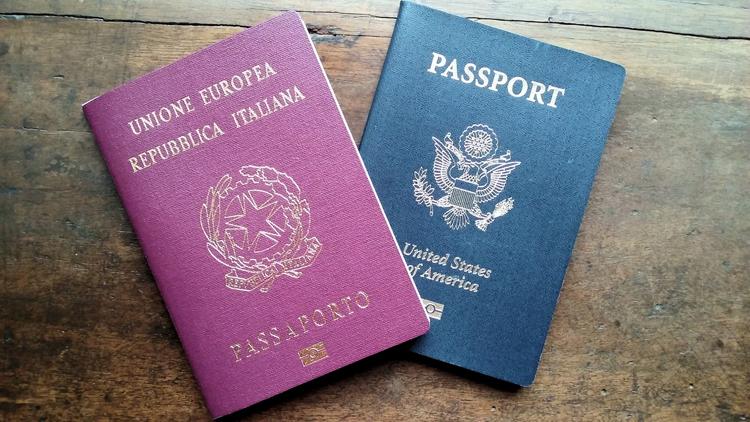
*UPDATE: As of March 28, Italy has dramatically changed its Jure Sanguinis law to limit eligibility. While it is likely to face constitutional challenges, much of the information below about eligibility (like the flow chart) is not currently accurate. Mi dispiace.*
The winds are changing around us. People of all temperaments can feel it, though individual interpretations of its meaning or its severity may vary. And in times of change, there are some qualities that are incalculably valuable. One of those qualities is flexibility. Adaptability, the skill to adjust as the ground beneath you shifts. In some ways, this must be a mindset. In others, tangible steps must be taken. To best prepare for the future, I’m digging into the past.
Family Background
My great-grandmother Kathleen was a wonderful woman. A widow in the years I knew her, she’d part the blinds to look out her farmhouse window before shuffling to the front door to let us in with a smile and a hug. I remember her love of baseball, cards, horses, cooking, and most of all, family. On holidays, she would make gnocchi in meat sauce from scratch. Fiery and passionate, she was outspoken but always kind. She was a woman to revere.
She, herself, was the daughter of Italian immigrants who had come from the comune of Corio in the early 20th Century. Corio, a few dozen kilometers northeast of Torino, was a small rural town like many scattered across Italy. So when Kathleen’s father immigrated to Washington as a laborer, he found work in the coal mines of Renton. In those years, there was a significant population of Italian immigrants from Renton up through the Rainier Valley into Seattle. Kathleen had Italian neighbors that became family through marriage, she managed an Italian restaurant in Downtown Renton in her younger years, and she frequented Borracchini’s Bakery in the Rainier Valley for celebratory cakes like so many Italian-American families in Seattle. Little did my family know, she was an Italian citizen despite never stepping foot on the European continent. And, by extension, we were too.
A Basic Understanding of Jure Sanguinis
Many countries around the world have citizenship by descent. But it usually only stretches back one generation. The Italians, due to their ancient history, have a unique citizenship law. The birthright to Italian citizenship can stretch across many generations. Here’s what that has looked like for my family.
In July, recognizing the importance of creating a more flexible future, I came across Jure Sanguinis. The principle is simple, the law is a bit more complicated. Let’s say you, like me, have an Italian great-great-grandparent who immigrated to the United States in 1906. They were born in Italy to Italian parents. Therefore, they are Italian citizens. They then had my great-grandmother, who was born on American soil to Italian parents. Because Jure Sanguinis passes down citizenship through lineage as a birthright, my great-grandmother was born as an Italian citizen, however never to be formally recognized. When my great-grandmother had my grandmother, she too was extended the birthright of Italian citizenship. When my grandmother had my father, that right was also given to him by birth. And so to me. And so to my future generations under current law. To be clear, this is not naturalization. I am not being granted citizenship. I am a citizen and this is simply recognition of my citizenship. This is an important distinction in my relationship with the Italian government. For an easier following of the lineage, it runs like this: GGF-GGM-GM-F-M.

The Process of Jure Sanguinis
Fortunately, my sister had dug into family genealogy for the last few years as a passion project. So when we began to dig for documents in July, she already had names, dates, and some of the pertinent documents we needed. It accelerated our process substantially. This is what the process looked like.
r/JureSanguinis Wiki
My brother and I began by learning about Jure Sanguinis via r/JureSanguinis and their invaluable Wiki was extremely helpful. It included eligibility charts and all steps that would need to be taken with pertinent FAQs that we stumbled across from time to time. If you are beginning this process, use this resource!
USCIS CoNE
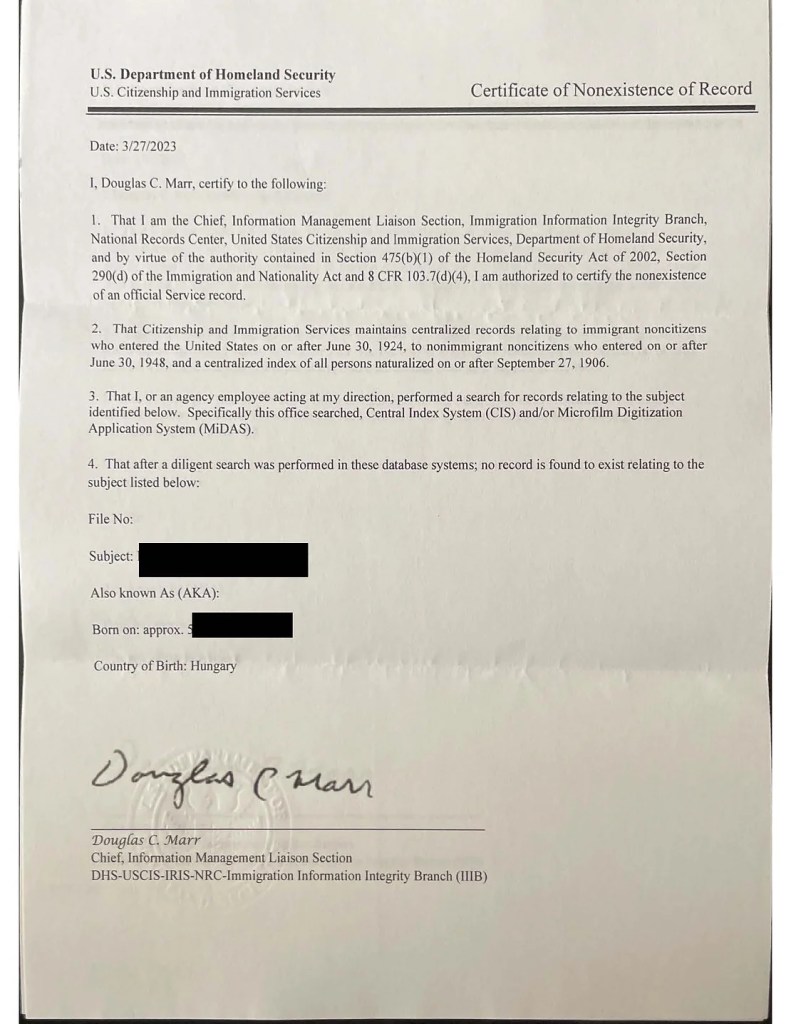
After studying the Wiki, our first step was to order a CoNE for our great-great-grandfather. This is a Certificate of No Existence of naturalization. In order to have an eligible line, the Italian born ancestor must not have naturalized as a U.S. citizen and therefore renounced their Italian citizenship. If they naturalized and renounced their Italian citizenship before their child was born, they would no longer have a right to pass Italian citizenship down. Fortunately for us, our genealogical research did not indicate any signs that our great-great grandfather had naturalized. All census documents during his lifetime listed him as only receiving his papers (naturalization was a two step process), but he never was documented as having naturalized. The National Archives also provided documentation that they had no record of his naturalization. And USCIS will likely do the same with the CoNE when we receive it in the next few months. Some more details below:
- Up until October 2023, the next in line only needed to be born before naturalization. The path would still continue on with a clarification of the “minor issue,” essentially an understanding of involuntary renunciation of Italian citizenship of the child as a minor allowing them to, in practice, retain their birthright to citizenship to pass down to future generations. However, a recent circolare changed the interpretation of the law and has since rejected petitions with the “minor issue.”
- As of 2024, CoNEs now cost $280 to request online and wait times are generally 6+ months. If your ancestor did naturalize and you can find that documentation through NARA or online archives potentially.
A 1948 Court Case
Because our line descends from my great-grandmother, this creates a legal challenge. The old citizenship laws from Italy’s founding of a nation in 1861 stipulated that only men could pass down citizenship. However, in 1948 new Italian laws considered this discriminatory against women and established that women could pass down citizenship. In the case of retroactive transmission of citizenship, however, it requires a legal petition. For lines that pass down through men until 1948, recognition of citizenship can be applied for through the consulate and do not require a court case.
In August, I had Zoom calls with a handful of lawyers to discuss our lineage, their comfort with our case, and fee structures. Unfortunately, a 1948 court case is substantially more expensive than the ability to pursue recognition of citizenship through the consulate. Quotes ranged from 5.000 to 11.000 euros for a family of 5 applicants. Some lawyers offered to do everything, while others suggested document collection would be left up to us. From a Facebook group, I heard about a well-regarded lawyer who more often works with Brazilian clients and reached out. Their quote was 3.700 euros. Due to strong communication and a good reputation, I hired them to represent us in our court case.
Document Collection
Next, I needed to collect all relevant documents for our petition. This included having them apostilled by the state. I needed my parents help for this part. In the state of Washington, only the grandchildren can request vital records for ancestors who are deceased. So I had my parents call VitalChek, Washington’s servicer, and request the following documents with apostilles (a $15 fee per document):
- Great-Grandmother’s Birth Certificate
- Great-Grandmother’s Marriage Certificate
- Grandmother’s Birth Certificate
- Grandmother’s Marriage Certificate
- Father’s Birth Certificate
- Father’s Marriage Certificate
- Siblings and My Birth Certificates
I also reached out to the Comune of Corio, Italy for the birth and marriage certificates of my great-great grandfather, which they promptly provided PDFs for. My lawyer then followed up and asked the comune to send those documents in print. They did this for free, although new laws allow comunes to charge up to 300 euros for vital records.
Regarding the American documents we ordered, most came back in good order within two weeks. In fact, all of them did except for one. My great-grandmother’s birth certificate was filled with inaccurate names. I assume this was due to language barriers at the hospital. My great-grandmothers first and last name were incorrect, her mother’s first and last name were incorrect, and her father’s last name was incorrect with a nickname used for his first name. A bit of panic set in. There was no way to amend this for accuracy and to go to court and have a judge sign off that these were the same individuals as those whose documents had correct spellings appeared time-consuming and expensive.
In consulting with my lawyer, they advised that I could search for my great-grandmother’s baptismal certificate. I tried, but my requests to the parishes came back without results. I then emailed the Archdiocese archives and, thankfully, they had located my great-grandmother’s baptismal record. And the names were accurate on this document. The birthdate also aligned with the birth certificate and my lawyer said this document would be acceptable to support the birth certificate. To get this document apostilled, I had to arrange a mobile notary to meet me and the archivist at the archdiocese offices and witness the archivists ecclesiastical seal and signature to notarize the baptismal certificate. I then sent this notarized certificate, along with a state archive “No record of Naturalization” letter to the state for apostille, which they returned in a few weeks.
Additionally, I needed to send National Archives documents to the U.S. Secretary of State for apostille. This proved more frustrating. In October, I mailed the documents and heard nothing from the state department for a month. Finally, I had a friend living in D.C. redeliver a new set of the documents during open hour walk-ins which assured a 10-day turnaround. Always good to know people!
Around the same time, we were getting close to filing, and our lawyer had us sign Power of Attorney documents so they could represent us in court. Quick enough, we had our signatures notarized at our local bank branches, I collected the documents from my family members, and I sent them to the state for apostille. My sister however, being married, had to complete a new one that included both her married name and maiden name. The notary would not notarize her signature with her maiden name because of her license, and the courts would need her maiden name since this would be her registered Italian name. So she completed a new Power of Attorney and sent it to the state for Apostille. She also ordered an apostilled copy of her marriage certificate to include in our documents for clarity.
In total, we had 20 documents that were apostilled by the State of Washington or the U.S. Government over the span of a month. During that time, my lawyer also put me in contact with a translator in Italy. For the court case, all documents would need to be translated to Italian. Quotes for this ranged from 600 euros to 2.000 euros. Fortunately, the 600 euro quote came from the translator my lawyer recommended. And although communication with the translator was a bit spotty, I trusted my lawyer’s recommendation.
Hurrying to File in Court
In early December, as I was awaiting the arrival of the last apostilled documents, the Reddit and Facebook pages I belong to started talking about fee increases. Legislation to be implemented on January 1 was set to dramatically increase the fees for filing a 1948 case by changing the filing fee from a flat rate of 518 euros for the case to 600 euros per petitioner. This would have increased our costs by over 2.500 euros. And while we were preparing to have to pay this escalated fee, we were really hoping to avoid it.
I reached out to my lawyer asking about the situation and what options were available. My lawyer said that as long as I could get them the translated documents by December 21, they could file before the new year. My translator assured my this would be possible if I could get them the documents by December 16. On December 11, I received all documents, double-checked them, and immediately went to my local DHL store to ship out all documents. This was the culmination of 4 months of work and close to $1,000 spent. I was nervous that I was doing everything right, but I was also now in a hurry to save 2.500 euros, too. I paid DHL for the fastest shipping and the documents arrived on the 16th. I didn’t hear anything from the translator until after Christmas. I had resigned to the fact that they didn’t get the translations done in time.
Then, a few days before the new year, my lawyer emailed me a PDF of the petition to ensure name accuracy. My lawyer had received the translations and filed our petition before the new year. We beat the deadline. To this end, I can not say how grateful and impressed I am with the effort my lawyer put into filing our case before the fee increase. I know many people who turned in their documents to lawyers before I did and were told it would be months before they could possibly file.
Next Steps
Now, we await the court process. It could take anywhere from 6 months to two years. And then the process to get a passport could take another year after that. Fortunately, the Torino courts appear to be quicker than those in the south and the comune that will register our citizenship is small and pretty responsive.
This is an exciting time for my family. While we do not immediately anticipate a move, we recognize the great value of being recognized dual citizens of Italy and the United States. Perhaps one of my sister’s children will go to a university in Europe one day, or maybe one of mine will. My brother has discussed eventually moving overseas. Having citizenship and the rights that come with it and not being limited to the restraints of a Visa is important for so many reasons.
As our 1948 case progresses, I will continue to update the journey. And if you have any questions, feel free to ask away!
 Tony Chiado
Leave a comment