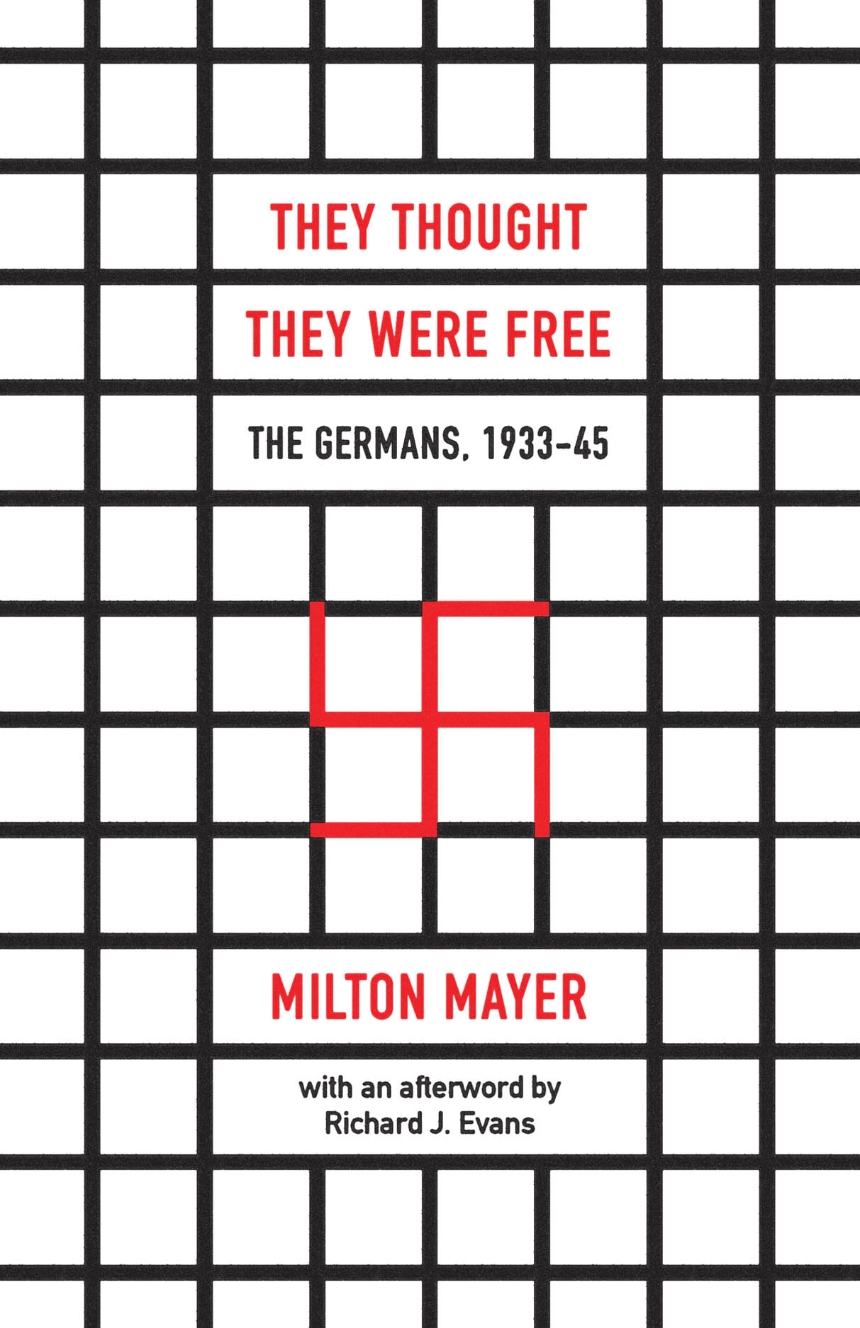
Like Milton Mayer wrote about the Germans under Nazism, we, too, will think we are free. The foundational concept etched into our collective ethos. Never to be the conquered, always to be the liberator. It should be a strength, the pride in our commitment to ideals of freedom. But it will become a prison as we desperately clutch to imagined freedoms. The more we will propagandize our own freedom, the more we will entrench our own oppression.
Mayer’s They Thought They Were Free immerses its readers in the deception of fascism. Consider the way fascist force pressures us to abandon our freedom of choice and, by extension, our humanity:
“Freedom is nothing but the habit of choice. Now choice is remarkably wide in this life. Each day begins with the choice of tying one’s left or right shoelace first, and ends with the choice of observing or ignoring the providence of God. Pressure narrows choice forcibly. Under light pressure men sacrifice small choices lightly. But it is only under the greatest pressure that they sacrifice the greatest choices, because choice, and choice alone, informs them that they are men and not machines.” – Mayer, 1955
We’ll be left with the small choices. At the grocery store, we’ll venerate the wall of peanut butter varieties. We aren’t like the communists, we will say, who had their freedoms stripped down to just one brand of peanut butter, chunky or smooth. Our petrostate will ensure the flow of oil. Chevron or Shell? No rationing at the gas pumps for us, a sure sign of freedom. We’ll still be able to buy Adidas or Nike or Puma or New Balance, ensuring that our individuality is displayed outwardly.
More importantly, the media will tell us we are free. The endless entertainment from social media and other apps. Mindless videos mixed in with hateful messaging and the reminder that the fascist regime is our godsend. Our unique algorithm will know, precisely how to keep so many of us in the dark. An onslaught on our sense of reality. We might ignore our screen time, because it shatters the illusion of freedom. It wakes us up to a harsh reality that we are slaves to media consumption: and worse, a media that lies to us through grinning teeth.
Our freedom, over time, has eroded from more noble concepts of the independent conscience to a consumeristic facade. What is freedom, then, to us? Like grass, it is a flag of our collective disposition. Freedom is only as liberating as what we dare to conceptualize. If our idea of freedom, as it is in the present moment, simply takes on a consumeristic hue, then we believe we are free but are instead prisoners. If our idea of freedom, as it was idealized by the transcendentalists for example, is a true sense and application of independent conscience, then we believe we are free, and we indeed are liberated.
Plato’s Allegory of the Cave, the old philosophic glimpse into the concept of perceived freedom, paints quite clearly our ability to collectively delude ourselves with a materialistic sense of freedom. Our illuminated shadows on the wall might be the selection of shoes on the wall in Footlocker or the peanut butter varieties at the supermarket. In tying these goods to freedom, we are saddled with a fallacy-ridden sense of power and purpose under a regime that strips such things from us. As the illusion of freedom dances on the cave walls, we are evermore incapacitated, unable to think of purer freedoms.
Similarly, James Baldwin’s The Fire Next Time understood something about American 60 years ago that few have even begun to understand today. We are not free until we can truly see the mechanisms that oppress us. Otherwise, we are beholden to them. He writes this to his nephew in the context of Black liberation: “We cannot be free until they are free.” It is worth pausing here a moment to note why Baldwin so acutely understood this when much of society didn’t. Firstly, he was one of America’s greatest intellectuals. But also, because throughout American History, African Americans and other minority groups have been subjugated and oppressed in such an explicit manner that the Trump’s Regime ushering of fascism in America is something they have experienced even when we were a conceptually free country.
Many brilliant intellectuals within (and without) the American tradition have understood an aspirational freedom that America claims but does not yet possess. It is one of independent conscience and exertion of free thought. It is one of great ponderance on how to contribute one’s independence to the collective. We will think we are free not because we have whetted our consciences but because we can consume at will. It is a fundamental betrayal of what humanity is. We are not hogs in the sty. In each of us is the gift of conscience, of rational thought, of individuality. Our freedom comes from that gift. We should hold fast to our independent conscience, else we too will foolishly think we are still free under fascism. And one day, it will all rush in upon us.
“And one day, too late, your principles, if you were ever sensible of them, all rush in upon you. The burden of self-deception has grown too heavy, and some minor incident, in my case my little boy, hardly more than a baby, saying ‘Jewish swine,’ collapses it all at once, and you see that everything, everything, has changed and changed completely under your nose. The world you live in—your nation, your people—is not the world you were born in at all. The forms are all there, all untouched, all reassuring, the houses, the shops, the jobs, the mealtimes, the visits, the concerts, the cinema, the holidays. But the spirit, which you never noticed because you made the lifelong mistake of identifying it with the forms, is changed. Now you live in a world of hate and fear, and the people who hate and fear do not even know it themselves; when everyone is transformed, no one is transformed. Now you live in a system which rules without responsibility even to God. The system itself could not have intended this in the beginning, but in order to sustain itself it was compelled to go all the way.”
 Tony Chiado
Leave a comment