In the present moment, the American Left is a disjointed big tent party with cliques turned inward at their own tables. Democratic Party approval has plummeted with its base. The result is that the path forward against the Trump Regime and its hardening brand of fascism is both highly uncoordinated yet impressively diversified. At one table, polite discussion insists on lowering the sail and weathering the storm. At another, stringent congressional opposition and a reliance on the courts is the way. In an assertive tone at the next table over, the battle-tested tradition of civil disobedience is hoisted to ancestors among the nighttime stars. And at a fourth table, a tense group are discussing what they perceive to be the inevitability of violence. Further back, hushed tones murmur other ideas. It is unclear if there is any plan to bring these tables together, or if they will even set aside their convictions to compromise on a path forward.
Polite Society and Tradition
Let’s nip the notion that this is a storm to be weathered. Fascism is an emergent condition that seems unlikely to yield its power willingly. I cannot think of an example where it has. Had the Allied Powers not toppled German and Italian forces during the Second World War, fascism may well have marched on into the latter half of the twentieth century. With internal oppositional collapse and without external intervention, there was little sign of its recession. Even with external intervention, Nazi Germany ruled for twelve years and Fascist Italy for twenty-one. This would be a long storm to weather. Given the widespread political persecution and the scapegoating of marginalized groups violently undertaken by the Trump Regime, it is a storm many would not survive.
I have similarly little faith in the reliance on our system of Checks and Balances. The perceptible infallibility of such a system with all its safeguards appears to have been mistaken. Court packing with loyalist partisans has loosened the courts’ relationship with impartial law in recent years. In the Legislative branch, a mixture of sycophantic party politics, threats of violence, and a miscalculation of the current political moment have led to a relinquishing of Congressional power at a rate I didn’t think possible mere months ago.
I believe the effort to exercise the system of checks and balances as much as possible against the fascists has worth. Its potential must be exhausted against the rise of fascism. The systems that safeguard our democracy have as much symbolic as functional meaning. People look to them for affirmation that their freedoms are preserved. But those who think that the system of checks and balances will prevail, I fear, are painfully fooled by a fantasy of more honest times. These are not honest times, and our honest systems are collapsing.
Civil Disobedience
The power for change, then, lays with the people. It always has, of course. This is, conceptually if not also practically, a government of the people, by the people, and for the people. But the action necessary must be much more direct now. There exists an active effort to mobilize the people bold enough to make noise against this regime. Protests, boycotts, strikes, work stoppages. The time-tested field tactics of the working class are being deployed. History has demonstrated their efficacy, and perhaps it has also overplayed it, as well.
In the schools, this is the brand of political dissidence we teach and learn about most. Frankly, it’s palatable to a wide audience because it isn’t as menacing as the alternative. It advocates for the non-violent efforts of the people to compel the better nature of the government. We can evoke Thoreau and Gandhi and King Jr and discuss their successes. It’s woven of our more hopeful disposition: that we hold a society civil enough where non-violent demonstration can press the collective conscience.
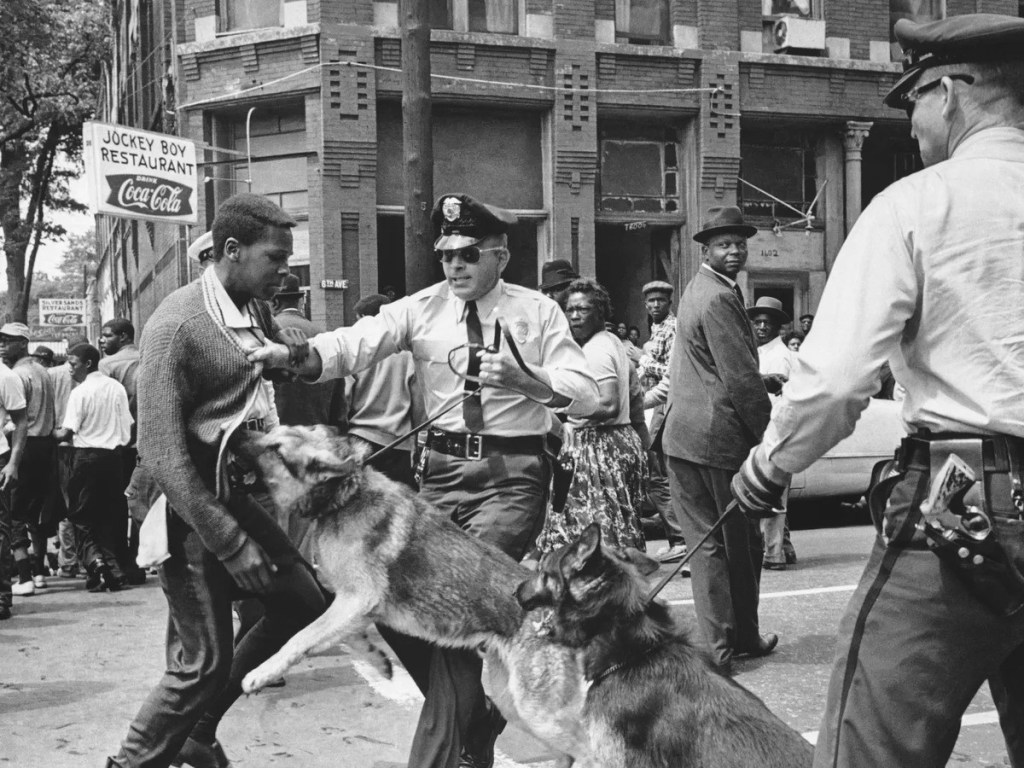
I have been at the protests, a brown cardboard sign in hand that reads, “Fight Fascism.” I believe in the power of civil disobedience. In its power to raise awareness and unite those with common aims. Various tactics have the power to pierce the veil of discourse that divides social classes. But this relies on a collective conscience formed of the combined well-intended consciences of individuals. Where those individuals have warped or altogether abandoned their consciences, as is done under fascism, civil disobedience risks finding itself a knight against tanks, a martyr on the political battlefield.
This is not to say those who believe in civil disobedience cannot withstand the fray. And it is not to say that their cause is not just, productive, or valued in the larger struggle. Of course it is. Those who march, who rally, who boycott, who strike, they force the issue into the public conversation. But I fear we overstate the power of civil disobedience in isolation.
It has rarely, if ever, existed in isolation, but has rather always been affirmed by a more firm fist. The uncomfortable truth of it all is that civil disobedience is a privilege afforded at least in part due to the grayer morals of others. Both Vietnam and Civil Rights protests were buttressed by the threat of losing public favor against foreign military foes. Thoreau’s tax protest was held up in the same principle. The mainstream abolitionists appeared a much more comfortable alternative than John Brown, though that devolved to unimaginable violence in the end anyway. Nevertheless, civil disobedience is tried and true in the political arsenal.
Violence
It is clear too, though, that a militant wing is sitting at a table under the tent. This table makes folks uneasy. They themselves are uneasy. Their very presence in the party is one of both necessity and reluctance, both for the party and the clique. They sit in the corner. All on the same side of the table, their eyes continuously scanning across the tent even as their lips form and their ears twitch. They certainly don’t wholly believe in polite society, the systems of tradition, and, for many of them, even their faith in civil disobedience has faltered. Some are dogmatic, others are disillusioned, and yet others are something else entirely. Whatever they are, they believe that the time for non-violence has passed, and in its wake an era of violence has begun.
As a society, we reject most political violence for obvious reasons. In our schools, we condemn the militant language of Malcolm X or the Black Panther Party, even though their impact on Civil Rights was notable (after all, it was in part Malcolm X’s militancy that drove white liberals to the fandom of King Jr). We dismiss Nat Turner and John Brown as radicals. The only political violence we collectively condone is that which founded our nation. Outside of that, it is beyond the pale of our better senses.
A society must hold such ideas. A violent society is no society at all; it is a wilderness for beasts. I have never met a man emerged from the horrors of war who did not sacrifice at least some of his civility. With this clear understanding, our society has never endorsed violence as a form of political resistance, even if we very much are a warrior culture. Though for good reason, it also means that we have avoided the more honest and discomforting conversations around political violence.
The emergence of widespread political violence would not be an engagement started by the Left, to be clear. Right-wing militants have been politically violent for well over a decade now in this country. They have shot protestors dead on American streets; They have attempted to kidnap Michigan Governor Gretchen Whitmer; They stormed the Capitol; And detailed investigative reporting shows the depth of this violent movement. In an understanding that this will continue, perhaps now even aided by the Federal government, that table in the corner of the tent is rejecting the call for socially palatable forms of resistance. To them, this is existential.
Violence is a last resort: the extant option when diplomacy has crumbled. It is never to be endorsed. But it is, perhaps, to be understood in its pragmatism and utility. Violence is outside of the norms of any society, and yet its specter upholds them. Its actors are similarly outside of society, and yet they quickly become heroes in the right circles or under the right conditions. Consider the outcry of support for Luigi Mangione, which would have been difficult to imagine a decade ago.
Such societal regression is harrowing, but it is a somber consequence of the oppression the people face. James Baldwin’s words are perhaps useful here: “If a society permits one portion of its citizenry to be menaced or destroyed, then, very soon, no one in that society is safe. The forces thus released in the people can never be held in check, but run their devouring course, destroying the very foundations which it was imagined they would save.” This is the natural progression of a society that wages violence against its citizenry. In sweeping the homeless camps; In clubbing protestors on the streets; In denying healthcare claims for the sick; In penalizing the poor for the benefit of the wealthy. Eventually, I fear, violence begets.
Where the non-violent actor believes in appealing to the state’s better nature, those preparing for violence believe that the fascist state cannot be compelled. To them, it must be forced. Into overplaying its hand, squeezing too hard, and breaking its ranks. From there, they argue, new political opportunities emerge to be seized upon by the people. In their Machiavellian view, the ends justify the means and if government is to be by the people, political leaders should fear the populace.
Such a strategy is daunting: if not for the unmetered suffering it may deliver, then for the unpredictability wrenched into its concatenation. Day by day, it feels as if our societal stride increasingly synchronizes with our heated pulse. The consequences could be horrific. So much could go so wrong. Death to loved ones and strangers, and to allies and foes will strangle our souls. But political violence is also here already, lurking around the corner. It haunts our collective hopes and dreams.
It is clear to me that some meaningful part of the American Left feels its back against the wall and only one way out. As fascist oppression roots itself in our society, this unnerving sense will only aggrandize among the people. Then, if checks and balances fail and civil disobedience is aggressively put down by the state as looks entirely possible, it only reifies the priors of this growing sect. To uphold the morals, the norms, and the principles so many believe in, little recourse may remain against fascism save for that feared specter.
Violence is never a desirable outcome, but I hold no certain premonition to tell this table flatly that they are beyond reason in such opaque times.
 Tony Chiado
Leave a comment